

The app’s interface is in Spanish. Screens, tabs and buttons are named as they appear, with their English meaning.
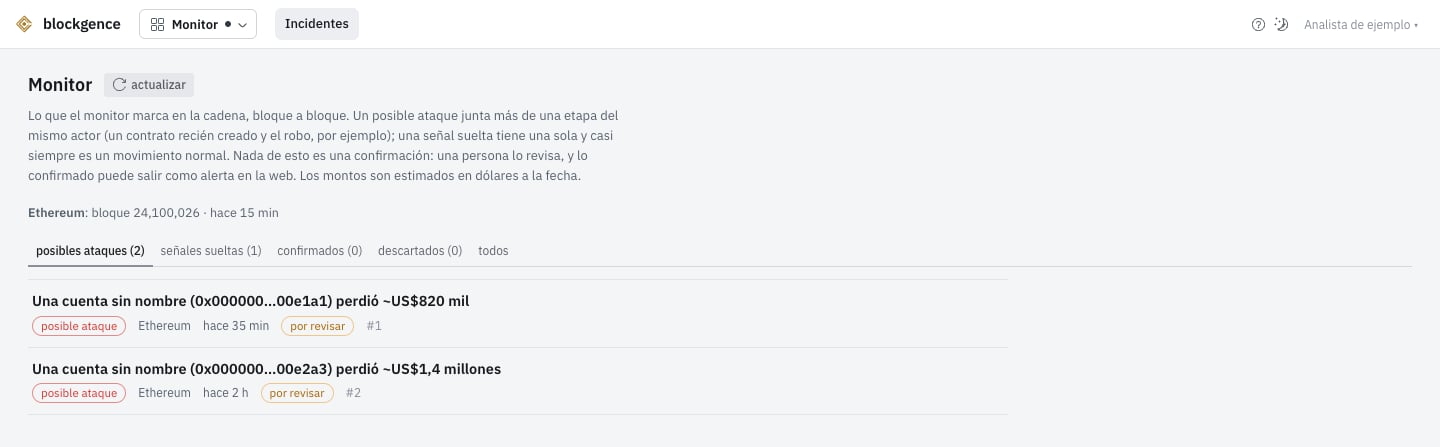
The incident list, with synthetic data.
What it detects
A transaction enters the analysis when a third party loses at least **US$100,000** net in it, or at least US$10,000 if the transaction took a flashloan. That transaction is then analyzed: who gained, whether the called contract is new, whether there was a flashloan, how many transactions the signer had sent before and which exploit patterns show up. Each incident has a level:
The stages it looks at:
Read an incident
1
Pick the tab
posibles ataques (possible attacks), señales sueltas (loose signals), confirmados (confirmed), descartados (dismissed) or todos (all). Each row says who lost and how much
(”… lost ~US$820K”), the level, the network, when, and the status: to review, confirmed or dismissed.
2
Read the card
At the top of the detail: the title, what happened in one sentence and the stages as chips. Below, the diagram of what
moved (who ended up losing and gaining each token, and the account-to-account movements) and the reasons, in short
sentences.
3
Open the technical detail if you need it
For each transaction: the rule that opened the incident with every condition it required and the measured value
(✓ met, ✗ not met, ? no data), why it entered the analysis, who lost and who gained by asset, the exploit signals, the
accounts it treats as the attacker’s and what it did not evaluate.
4
Follow up from there
Every address has rastrear (trace: opens Investigation from that address) and vigilar (watch: loads it in Guard
as an attacker’s wallet). Every transaction opens its own page.
A condition without data is never taken as met: it is shown as “no data”.
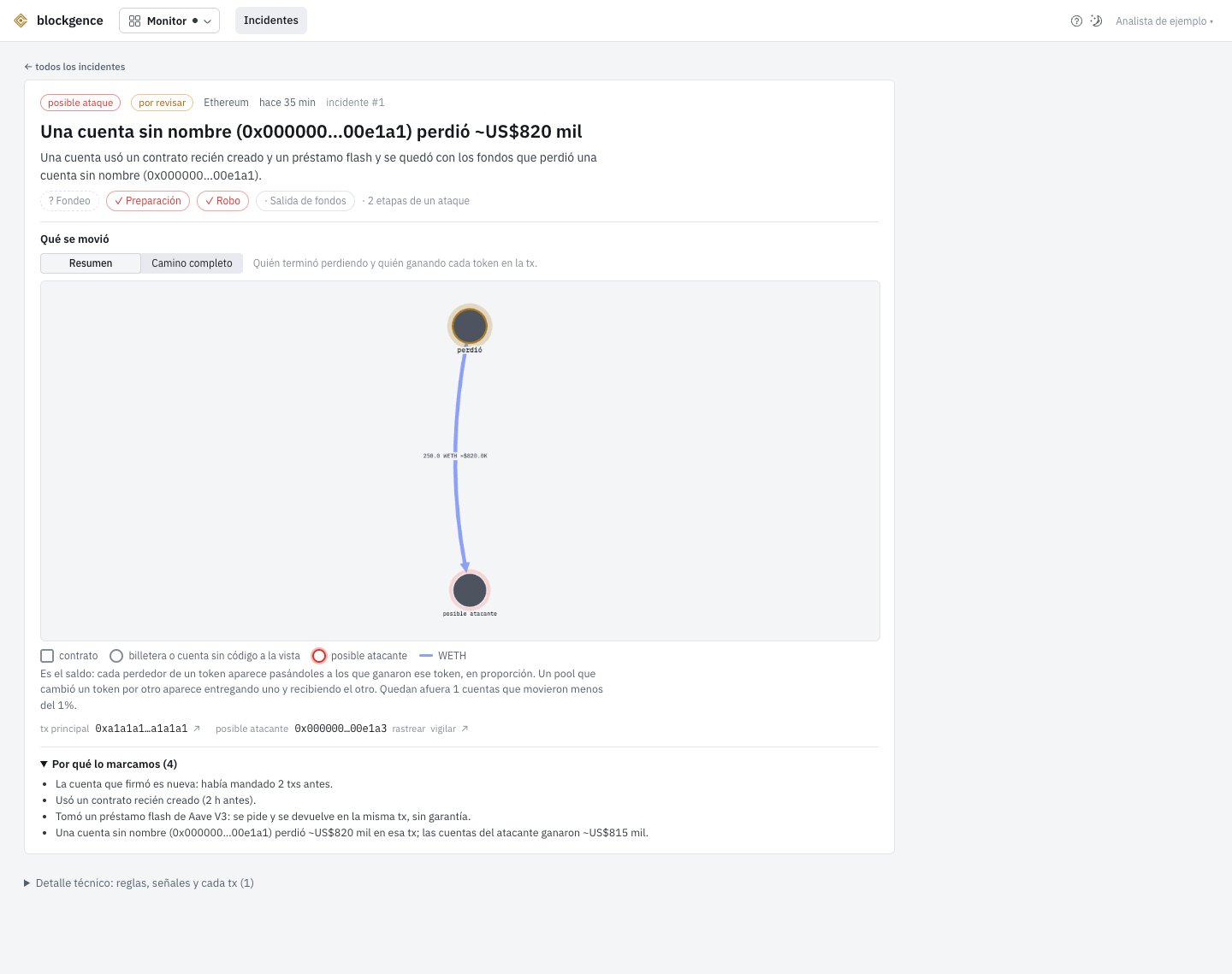
The detail of an incident, with synthetic data.
Confirmed incidents and public detections
An incident stays to review until someone at Blockgence confirms or dismisses it. Confirmed incidents can be published in the Detections section of blockgence.com: one alert per incident, with the network and the transactions, without USD amounts or addresses.What it does not cover
- Ethereum only. Other networks are not monitored block by block.
- What falls outside the threshold and the rules: exploits by token minting, unpriced tokens, losses split across many small transactions, and attacks signed by bots with thousands of transactions.
- The rules are measured against known hacks, but they do not catch every one, and a signal is not a verdict: an incident to review can be a legitimate movement.
- Monitor does not send alerts outside the app and has no public API. To get alerts on your own wallets, or to follow an attacker, use Guard.
- It does not freeze or block anything: it describes what happened on chain.